
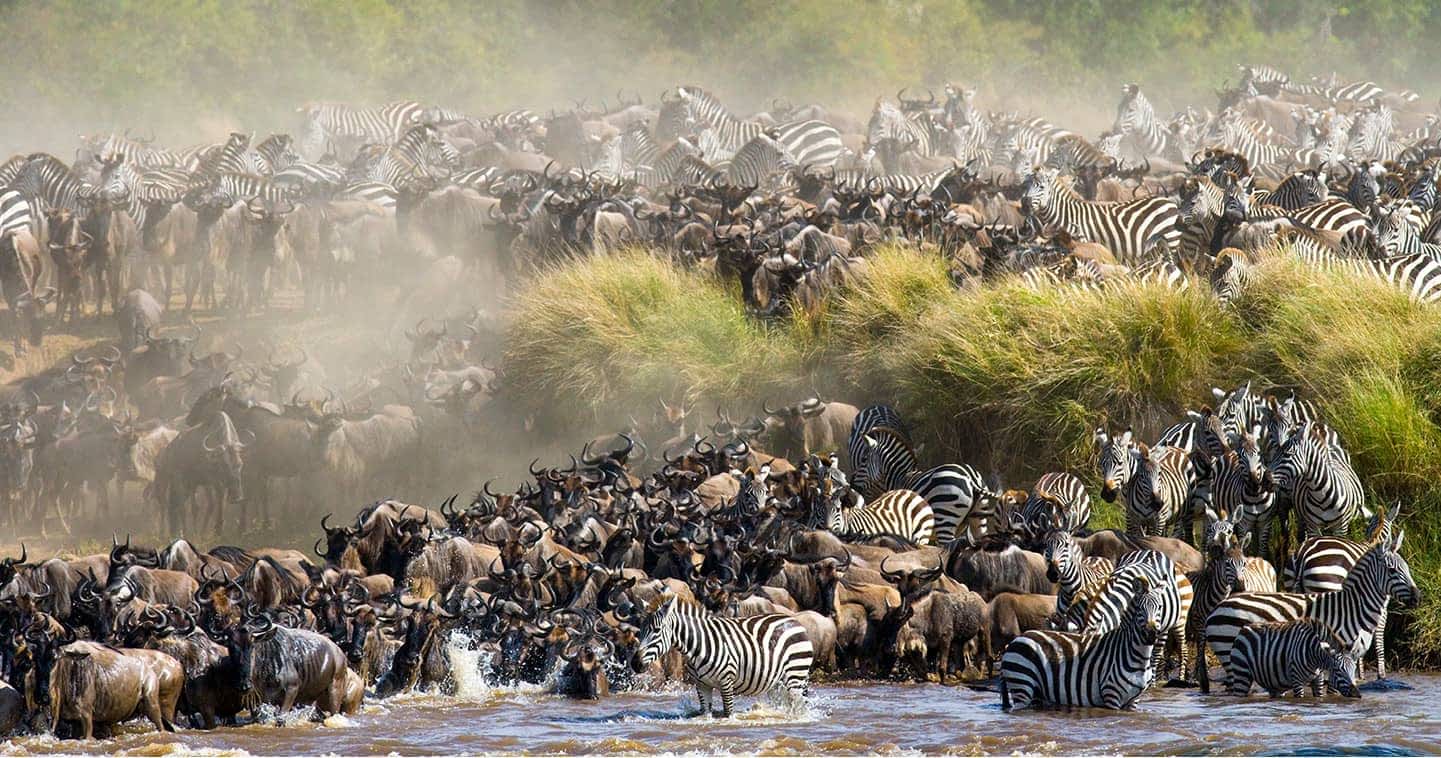
The Great Migration Kenya is not a single event. It is a continuous, year-round movement of nearly two million animals circling a shared ecosystem that spans Tanzania and Kenya. The phase that draws most travelers to the Maasai Mara runs from July through October, when wildebeest and zebra attempt the most dangerous river crossings on the African continent.
This article covers how the migration cycle works, what you will actually see in Kenya, when to visit depending on what you want, and what to expect at different points in the season.
What Drives the Great Migration
The migration is governed by rainfall and grass growth, not instinct alone. Wildebeest follow the green flush that tracks seasonal rain across the Serengeti-Mara ecosystem. The route covers more than 800 kilometers in a clockwise loop, and the herds have traced it for millennia. This rhythm has stayed intact because the ecosystem itself remains largely connected, which makes it one of the last functioning large-scale wildlife migrations on the planet.
The animals involved in the movement:
- Approximately 1.5 million wildebeest
- 200,000 zebras
- 350,000 Thomson’s gazelles
The annual cycle breaks into four broad phases:
| Phase | Location | Months |
|---|---|---|
| Calving | Southern Serengeti, Tanzania | January to March |
| Northward movement | Western Corridor and Grumeti River, Tanzania | April to June |
| Mara River crossings | Maasai Mara, Kenya | July to October |
| Return south | Eastern Serengeti, Tanzania | November to December |
The calving season between January and March produces more than 500,000 young wildebeest in a compressed window. Predators concentrate to exploit the abundance, and the southern Serengeti becomes an intense, if difficult to witness, study in survival. By April, the herds press northwest. The Grumeti River in Tanzania provides a smaller preview of what awaits at the Mara. By July, the leading edge of the migration reaches Kenya.
Why the Maasai Mara Is the Prime Viewing Ground
Kenya’s Maasai Mara National Reserve occupies the northern corridor of the Serengeti ecosystem. It is smaller than the Serengeti itself, and that compression works in the viewer’s favor. Animal density during migration season is very high. The open savannah terrain also makes predator sightings more consistent than in landscapes with heavier bush cover.
The Mara River crossings are the centerpiece of the Kenya experience. At points including Lookout Hill and Paradise Crossing, wildebeest gather on the southern bank in groups of hundreds or sometimes thousands, hesitating before the plunge. What follows is worth the wait: the animals leap into fast-moving water, Nile crocodiles surge from below, and the opposite bank becomes a scramble of climbing, slipping, and occasionally drowning animals. Some crossings last minutes. Some stretch for hours. A single morning can produce one crossing or several.
Kenya’s reserve also imposes fewer restrictions on off-road driving than some Tanzanian parks, which gives guides more flexibility in positioning vehicles near active crossings or predator sightings.
Great Migration Kenya: Month-by-Month Guide
July to August
The first large herds typically enter the Mara in July, though the exact timing shifts by weeks from year to year. By mid-July in most seasons, river crossings are occurring with some regularity.
This is the busiest period. Popular crossing points will have multiple vehicles parked along the bank. Accommodation prices reach their highest, and bookings at well-regarded camps fill out months in advance.
What to expect during this window:
- Daily or near-daily crossing attempts, weather and herd position permitting
- High predator activity along river banks and open plains
- Full lodges and tented camps at premium rates
- The highest probability of witnessing a crossing on any given day
September to October
September is widely regarded as the most balanced time to visit. Herds spread across the Mara. Crossings continue. Tourist numbers begin to ease, and vehicles thin out at the main crossing points. Photography conditions shift as the light changes through spring in the southern hemisphere.
What to expect:
- Consistent crossing activity through most of September
- Quieter camps with better availability and shorter booking lead times
- Somewhat lower pricing compared to the July peak
- Strong big-cat sightings as predators follow the herds
November
By November, short rains arrive in northern Tanzania and the herds begin to reverse course. Stragglers remain in the Mara into early November in most years, but the bulk of the animals have departed by mid-month.
What to expect:
- Very few other tourists
- A green, lush landscape as the rains arrive
- Lower accommodation rates across the board
- Exceptional birdwatching as migratory species appear
Beyond the River Crossings
The Mara’s appeal does not begin and end with wildebeest. The reserve holds a full suite of wildlife year-round.
Big cats. The Maasai Mara has one of the highest predator densities in Africa. Lion prides hunt cooperatively on open grassland, making full hunts visible in a way that dense bush prevents. Cheetahs use termite mounds and low rises as vantage points before sprinting. Leopards rest in the forks of acacia trees, often with a recent kill draped nearby. All three can be seen reliably even outside migration season.
Birdlife. More than 450 species have been recorded in the reserve. During and after the short rains, the variety expands considerably. Lilac-breasted rollers perch on exposed branches and fencing. Secretary birds move through tall grass on foot, hunting methodically. Martial eagles scan open ground from height.
Maasai communities. Many camps operate alongside Maasai communities whose land borders or overlaps the reserve. Visits offer a different kind of encounter, one focused on pastoralism, land rights, and the relationship between people and wildlife that shapes the Mara’s long-term future as much as any formal conservation policy.
Balloon flights. Hot air balloon flights over the Mara at sunrise are available from several launch sites near the reserve. The perspective from altitude changes how you understand the scale of the landscape and the movement of the herds below. Prices are high, but the experience cannot be replicated from the ground.
Explorer Notes
Crossings cannot be scheduled. A 6 a.m. departure may result in a six-hour wait at the river before anything happens, or a crossing within the first thirty minutes. Guides monitor herd movement through radio networks connecting drivers across the reserve, but the herds make their own decisions on their own timeline. Plan full days at the crossing points rather than half-day trips.
Clothing and gear. Mornings in the Mara are cool year-round. Midday heat arrives fast. Afternoons can turn cold quickly with cloud cover, particularly August through October. Neutral-colored clothing in khaki, olive, or beige is practical: it avoids disturbing animals and shows less of the constant dust than darker or brighter colors would. A light fleece for early morning game drives is genuinely useful, not just precautionary.
Camera considerations. A telephoto lens of at least 200mm is the practical minimum for river crossing photography. Subjects are often 30 to 80 meters away across the water, and crossings move quickly. A 300mm or 400mm lens gives more working room. Dust is persistent throughout the dry season. A UV filter protects the front element between drives.
Binoculars. 8×42 or 10×42 binoculars suit open-savannah conditions well. Bring your own regardless of what a camp supplies.
Booking lead time. Well-positioned camps during migration season book out six to twelve months ahead. If you have specific July or September dates and a preferred property in mind, that timeline is not an exaggeration.
Planning Your Visit
Direct access to the Mara is available via Nairobi’s Wilson Airport on scheduled light aircraft flights to airstrips inside or adjacent to the reserve. The drive from Nairobi takes five to six hours via the A104 highway southwest through Narok. Most travelers combine a Mara stay with at least one other Kenyan destination. Amboseli, for elephant viewing against the Kilimanjaro backdrop, and Lake Nakuru, for flamingos and rhino, are the most common additions.
The Maasai Mara National Reserve charges a non-resident daily park fee. Private conservancy areas surrounding the reserve boundary operate their own fee structures, which fund community and conservation programs. These conservancies often permit off-road driving and night game drives that are not allowed inside the national reserve itself, which makes them worth considering depending on what you want from a visit.
Kenya Wildlife Service publishes current fee schedules on their official website. Fees have changed in recent years and vary by residency category, so confirm current rates before finalizing a budget.
The Maasai Mara does not have a true off-season. It shifts character across the year rather than shutting down. Migration or not, the resident wildlife and the landscape alone make it one of the most consistently productive safari destinations on the continent.
Every trip described here can be tailored: dates, budget, camps, and pace built around you.
Get a Personalised Safari



[…] – 2-Day Ol Pejeta: Dedicated rhino and chimp experience – 3-Day Ol Pejeta + Masai Mara: Conservation and migration – 4-Day Ol Pejeta + Amboseli: Rhino tracking and elephants […]
[…] Masai Mara (July–October): […]
[…] combines the thrill of safari with the bliss of coastal relaxation. After tracking lions in the Masai Mara or photographing elephants at Amboseli, Diani Beach offers the paradise you’ve been dreaming […]
[…] guide clarifies exactly what each option delivers in the Masai Mara context, so you can choose the right base for your […]